


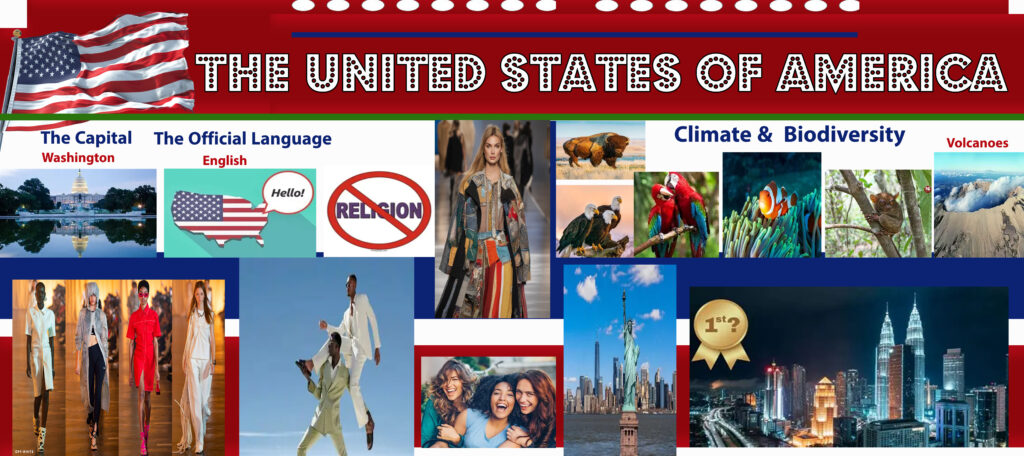
General Information
1- It’s the world’s third-largest land area
The United States is the third-largest country in the world, covering approximately 9,833,517 square kilometers (3,796,742 square miles). It is only slightly smaller than Russia, which is the largest country, and just behind Canada.
2- The Role of the President of the United States
U.S. head of state
Leader of the executive branch
Commander in chief of the armed forces
3- The Role of the First Lady in America
The role of the First Lady in America has evolved significantly over time. Historically, the First Lady was primarily a ceremonial figure, hosting events and serving as a symbol of the presidency. However, over the years, the role has expanded to include public advocacy, addressing social issues, and influencing fashion and public opinion.
The First Lady is often seen as a spokesperson for the president, representing him at official events and ceremonies.
First Ladies have taken on various responsibilities
including managing the White House and participating in political campaigns.
The role has also been used to promote social causes and advocate for women’s rights and empowerment.
Each First Lady has shaped the role according to her vision, with some focusing on education, healthcare, and environmental issues.
the First Lady plays a crucial role in shaping public perception and influencing policy in the United States.
Since The United States the head of the world, We Must know about its Politics how it Works on the Ground
It’s States
The United States is composed of 50 separate states
Why are they separate states?
The United States is composed of 50 separate states, each with its own government, laws, and culture. This structure is based on the principle of state sovereignty, which is enshrined in the Tenth Amendment to the U.S. Constitution. The states are sovereign jurisdictions, meaning they have the authority to govern themselves and make decisions on matters not delegated to the federal government. Each state has its own constitution and government, and all states and their residents are represented in the federal Congress. The states are organized into a federal republic, where the federal government operates alongside the states. This system allows for a balance of power and individual autonomy while maintaining a unified national identity.
It’s Populations
It’s the third-largest population, exceeding 340 million
It’s Capital
The capital of the United States is Washington, D.C., which is formally known as the District of Columbia. It has been the federal capital since 1800.
It’s Located
North America
The United States of America, also known as the United States or America, is a country primarily located in North America. It is a federal republic of 50 states and a federal capital district, Washington, D.C. The 48 contiguous states border Canada to the north and Mexico to the south, with the semi-exclave of Alaska in the northwest and the archipelago of Hawaii in the Pacific Ocean. The United States also asserts sovereignty over five major island territories and various uninhabited islands in Oceania and the Caribbean. It is a megadiverse country
The Official language
Recent Developments
On March 1, 2025, President Donald Trump issued Executive Order 14224, officially declaring English as the official language of the United States. This order emphasizes the importance of a unified language for fostering a cohesive society and facilitating communication among citizens.
The Official Religion
No Official Religion
The United States does not have an official religion; the First Amendment to the Constitution prohibits the establishment of any state religion.
Constitutional Framework
The First Amendment of the U.S. Constitution explicitly states that “Congress shall make no law respecting an establishment of religion, or prohibiting the free exercise thereof.” This clause establishes a clear separation between church and state, ensuring that the government cannot favor one religion over another or impose religious practices on its citizens.
While Christianity is the most widely practiced religion in the United States, with a significant majority of the population identifying as Christian, the country is characterized by a diverse religious landscape. This includes various denominations of Christianity, as well as Judaism, Islam, Buddhism, Hinduism, and many other faiths.
Current Trends
In recent years, the religious composition of the U.S. has been evolving, with a growing number of individuals identifying as religiously unaffiliated or “nones.” Despite this trend, a significant portion of the population continues to express belief in a higher power or engage in spiritual practices.
Let’s Know about the Followings
1- The Commonwealth
The Commonwealth is a voluntary association of 56 independent and equal sovereign states encompassing many ethnicities and faiths. Each is committed to upholding shared values and principles to promote and protect
Democracy
Human Rights
the Rule of Law
Equality for all citizens
in accordance with the Commonwealth Charter
The modern Commonwealth
spans the six regions of Africa, the Americas, Asia, the Caribbean, Europe and the Pacific.
Thirty-one members are small states, many of which are island nations. The total population is assessed at 2.5 billion people, approximately one third of the world, of which 1.5 billion are under 30 years of age. the relevance and strength of the modern Commonwealth lies in its network of diaspora, cultural and sporting links, the widespread use of a common language and a strong shared legal heritage. These values, characteristics, and interests have engendered a common interest and trust between the peoples and communities of this unique and widely diverse association of independent countries.
Outside of the core of inter-governmental agencies
the Commonwealth benefits from a number of civil society and professional bodies that represent the evolution of the modern Commonwealth and the many links between peoples, communities and interests upon which it is built. The Royal Commonwealth Society is a leading body within this group of independent organizations.
The Commonwealth is an association of countries that share a common allegiance to the British monarch, which includes the United Kingdom. As of 2025, there are 15 Commonwealth realms, with the United Kingdom being one of them, along with other countries like Canada, Australia, and New Zealand.
2- The Congress
The Functions of Congress
Legislating
Introduction of Bills: Bills can be introduced in either the House or the Senate, except for revenue bills, which must originate in the House.
Committees
Bills are referred to specialized committees that review, amend, and vote on them. Key committees include the House Ways and Means Committee and the Senate Judiciary Committee.
Floor Debate
If a committee approves a bill, it goes to the floor of its respective chamber for debate. In the House, debate is often limited by rules, while the Senate allows for unlimited debate unless cloture is invoked to end a filibuster.
Voting: After debate
the bill is put to a vote. If it passes in one chamber, it goes to the other chamber for consideration.
Conference Committee
If the House and Senate pass different versions of a bill, a conference committee made up of members from both chambers works out the differences. The revised bill must then be approved by both chambers.
International organization membership of the United States
The United States is an active member of various international organizations, including the United Nations, which includes participation in the UN’s Six Principal Organs: the General Assembly, Secretariat, International Court of Justice, Security Council, Economic and Social Council, and Trusteeship Council. The country has also signed treaties with the International Criminal Court, although it has not ratified it.
The Congress
The U.S. Congress is the legislative branch of the federal government, responsible for making laws. It is bicameral, meaning it has two houses: the Senate and the House of Representatives. This structure is designed to balance the interests of states with large and small populations.
3-The ruling class in the United States of America (the extreme right )
The extreme right in the United States has been characterized by a combination of ultraconservatism, white nationalism, and other far-right ideologies. This group has gained significant power and visibility in recent years, particularly under the influence of figures like Donald Trump. The ultra-right has managed to gain control of key centers of power, including the judiciary and the media, and has expanded its sphere of influence. This shift has been accelerated by the political polarization and fragmentation of the ruling class, which has been a long-standing reality in U.S. politics.
The rise of the ultra-right can be attributed to a well-thought-out strategy set in motion over the past four decades by conservative minorities seeking power. This strategy has involved gradually occupying positions of power, expanding the ultra-right’s influence, and creating a social divide similar to that of the secessionist wars. The ultra-right’s agenda includes the tightening of abortion laws, the 2021 storming of the Capitol, and a flare-up in racist violence.
The political landscape has been transformed by the rise of the ultra-right, which has leveraged fear of modern threats to draw new adherents and encourage support for a more militant approach. This evolution has led to a more militant approach to countering perceived threats, with a focus on social and economic threats in the modern and postmodern world.
Jacobin
The ruling class in the United States, including the extreme right, has been shaped by a combination of neoliberalism, economic crises, and the need for a more centralized control of the state. This has led to a loss of class consciousness on the right wing and a new political landscape that revolutionaries need to understand.
Nationalism is a modern movement. Throughout history people have been attached to their native soil, to the traditions of their parents, and to established territorial authorities, but it was not until the end of the 18th century that nationalism began to be a generally recognized sentiment molding public and private life and one of the great, if not the greatest, single determining factors of modern history.
The Ultraconservatism is a political ideology that emphasizes the preservation of traditional values, institutions, and social norms. It often resists social change and is characterized by a strong sense of nationalism and a desire to maintain the status quo. Ultraconservative groups and individuals typically advocate for limited government intervention in the economy, a strong emphasis on law and order, and a strict adherence to traditional moral values. They often oppose social change, such as LGBTQ rights or immigration reform, viewing them as threats to the stability of society.
4- U.S. Peacekeeping
The United States is actively involved in peacekeeping operations globally, primarily through the United Nations (UN) and other international organizations. Peacekeeping activities are designed to create conditions for lasting peace, reduce civilian and battlefield deaths, and prevent the resurgence of conflict. U.S. peacekeepers, often referred to as part of multinational forces, may include military personnel, police officers, and civilian staff.
Global Peace Operations Initiative (GPOI)
Launched in 2005, the GPOI is a U.S. initiative aimed at enhancing the effectiveness of UN and regional peace operations. The program focuses on:
Capacity Building
Supporting partner countries in developing critical mission capabilities to address shortfalls in peace operations. Currently, GPOI collaborates with 48 partner countries to enhance their peacekeeping capabilities.
Training and Readiness
Assisting partner nations in planning, training, and preparing operationally ready units for peace operations, ensuring they can sustain their forces effectively.
Operational Support
Enabling partner countries to conduct effective operations and sustain their equipment while deployed, which is crucial for maintaining peace and security in conflict-affected regions.
Impact of U.S. Peacekeeping
U.S. involvement in peacekeeping has been shown to reduce the risk of renewed warfare and support the establishment of stable governance in post-conflict areas. By providing training, resources, and operational support, the U.S. contributes significantly to international peace and security efforts, reinforcing its commitment to global stability.
The Biodiversity & Climate
The climate of America is diverse, ranging from arctic conditions in Alaska to tropical climates in Florida, influenced by geography, latitude, and regional features.
Climate
The United States experiences a wide variety of climates due to its vast size and diverse geography. Here are the main climate types found across the country, Climate Change Impact: Recent trends indicate that climate change is affecting weather patterns across the U.S., leading to more extreme weather events, rising temperatures, and shifting precipitation patterns. This has implications for agriculture, water resources, and ecosystems throughout the country.
Biodiversity
Biodiversity in the United States is facing significant challenges, with approximately 34% of plants and 40% of animals at risk of extinction, alongside 41% of ecosystems at risk of collapse.
Current State of Biodiversity
The United States is home to a rich variety of species and ecosystems, but recent analyses reveal alarming trends in biodiversity loss. According to a report by NatureServe, 34% of plant species and 40% of animal species are currently at risk of extinction. Additionally, 41% of ecosystems are facing the threat of range-wide collapse, primarily due to habitat degradation, invasive species, climate change, and other anthropogenic pressures.
Conservation Efforts
The U.S. government has committed to significant conservation initiatives aimed at reversing biodiversity loss. The America the Beautiful initiative aims to conserve at least 30% of U.S. lands and waters by 2030. This initiative includes a $1 billion public-private partnership to support ecosystem restoration projects and enhance access to nature.
The primary threats to biodiversity in the U.S. include
Habitat Degradation
Urbanization, agriculture, and deforestation lead to the loss of critical habitats
Species
on-native species can outcompete, prey on, or bring diseases to native species, disrupting ecosystems.
Climate Change
Altered weather patterns and rising temperatures affect species distributions and ecosystem health.
Volcanoes
Why USA have a lot?
Location along the Pacific Ring of Fire
The United States has a high number of volcanoes due to its location along the Pacific Ring of Fire, where the Pacific Plate collides with the North American Plate. This collision creates tectonic activity that leads to volcanic eruptions. Additionally, the Aleutian Islands, Alaska Peninsula, and the Hawaiian Islands are known for their volcanic activity. The U.S. Geological Survey (USGS) has identified about 170 potentially active volcanoes nationwide, with the highest concentration in Alaska, Hawaii, and the Pacific Northwest. These volcanoes are not only significant geological features but also play a crucial role in shaping ecosystems and supporting scientific research.
The Clothing
The clothing industry in the U.S. features a mix of American-made brands, sustainable practices, and a significant shift towards overseas manufacturing.
American-Made Clothing Brands
The U.S. has a variety of clothing brands that pride themselves on manufacturing domestically. Some notable brands include:
American Giant: Known for high-quality basics, this brand focuses on producing clothing in the U.S. while cutting costs by avoiding traditional retail overhead.
Duckworth: A Montana-based company that emphasizes sustainability by managing the entire production process from sheep to shelf.
Goodwear: Renowned for its commitment to quality and American craftsmanship, producing all its garments in the U.S. for over 40 years.
All American Clothing: Offers a wide range of apparel made entirely in the U.S.
The Peace and Security in USA
The United States is committed to strengthening global resiliency and promoting peaceful, self-reliant nations. The U.S. Government is implementing the ten-year U.S. Strategy to Prevent Conflict and Promote Stability, focusing on democratic governance and respect for human rights. The strategy aims to confront destabilizing transnational challenges and create new models for cooperation. The State Department will lead this whole-of-government Strategy, aligning U.S. capabilities in diplomacy, development, and the security sector.
Inside USA
America is currently facing internal unrest, particularly in the form of protests and violence related to immigration policies. The National Guard and U.S. Marines have been deployed to manage these protests, indicating a significant level of unrest. Additionally, the political polarization and economic inequality have contributed to a deteriorating internal environment, raising concerns about potential civil unrest.
Outside USA
The United States is currently facing a range of potential external unrest, particularly in the Middle East and the ongoing conflict in Ukraine. These conflicts are expected to have significant impacts on U.S. interests and could escalate further, leading to various outcomes. Additionally, there are concerns about civil unrest in the U.S. due to polarized elections, legal proceedings, and economic instability. These factors contribute to a volatile and unpredictable environment, with the potential for unrest to spread across the nation.
Thanks for reading..
Congratulations 👏@Dina, work well done ✅
yes, it’s done as much as we able to collect the data, thanks Martin for courage us a lot.