


It's Located in
Spain is a transcontinental country located in southwestern Europe and northern Africa
It's Capital
Madrid
The Official Religion
Spain has no official religion
As established by the Spanish Constitution of 1978, which abolished the Roman Catholic Church as the state religio, Spain is considered a non-confessional state, meaning it does not recognize any official religion, although the Catholic Church maintains a significant presence in society, While there is freedom of religion, the Catholic branch of Christianity remains the most widely professed religion in the country
The National and Official Languages
Spanish, Catalan, Galician, Occitan, Basque
It's Landmarks
Alhambra, Granada
UNESCO Approved
The Alhambra is probably the most famous landmark in Spain. It’s the world’s last and greatest Moorish fortress. the Alhambra is one of the most visited sites in Spain, and even in the world. The orange toned Alhambra sits on a stunning piece of real estate – a high, mountainous location on Sabika Hill with sweeping views over Granada. Alhambra became a UNESCO site in 1984. It’s a deeply affecting place. It’s so beautiful and enchanting, it’s difficult to process. Or to unglue your camera from your face.
The Nasrid Palace
It is the finest example of the refined, intricate, and elegant architectural style of the Moorish civilization. Every inch of its rooms are decorated, top to bottom, with ceramic tiles, elaborate plaster work, calligraphy, filigreed windows, and stucco stalactite ceilings. the Nasrid sultans didn’t limit themselves to building within Alhambra’s ramparts. Just beyond the walls lie the Generalife Gardens, one of the best preserved Nasrid estates. Generalife was the lush leisure villa of the last dynasty of Moorish sultans. They spent their summers here to escape the intense heat. Generalife is considered one of Europe’s most beautiful formal gardens.
Casa Battlo, Barcelona
Antoni Gaudí ‘s Modernist masterpieces, now museums, are among Barcelona’s must see and most visited sites. To many Catalonians, Barcelona is Gaudí. Or at least he’s the city’s unofficial saint, Casa Batlló is Gaudí at his hallucinatory, dreamlike best. The building is a must-see site in beautiful Barcelona, especially if you love Modernist architecture or are on the Gaudí trail in Barcelona. For Casa Batlló, Gaudí conjured a building in the image of a dragon. The strange bone-like facade commands your attention. It’s studded with skull mask balconies and capped by a sinuously scaled roof with a solitary sword-like tower.
Sagrada Familia, Barcelona
Sagrada Familia is one of the most famous landmarks in Spain and the crowning jewel of Barcelona. Gaudí’s wildly creative opus. Construction began on the “Sandcastle Cathedral” in 1882. This famous landmark in Spain is still unfinished (but ongoing). When it’s completed, Sagrada Familia will be the world’s largest church with 18 tapering towers. The exterior appears like a strange looking sandstone mountain. It’s a hodgepodge of architectural styles with spindly towers of various heights. There are three facades –the Nativity, Passion, and Glory facades. Each appear like huge altarpieces, depicting different themes.
Palau de la Musica Catalana, Barcelona
Palau de la Música Catalana is a gaudy rose-covered wonderland and must see site in Barcelona. This magnificent concert hall was designed in 1905-08 by Lluis Domènech i Montaner — an architect who was just as famous as Gaudi at the time. Palau de la Musica is located along a claustrophobic, densely packed street in the Gothic Quarter. Montaner countered the claustrophobia with color and levity. The arches and intricate mosaic columns draw your eye up to the roofline. Stained glass windows bring in the natural light.
Do's and Don'ts
Don’t Skip the Local Markets
Spain has bustling food markets, like La Boqueria in Barcelona or Mercado de San Miguel in Madrid. Here, you can find many local specialities, fresh produce, and unique ingredients. Even if you’re not cooking for yourself, wandering through these markets offers insight into the local and regional food. Many markets now have a selection of delightful tapas and food bars mixed with the food stalls, you won’t find fresher food anywhere.
Don’t Expect Flamenco Everywhere
Flamenco is often associated with Spain, but it’s primarily from Andalusia, a region in the south. While you’ll find flamenco performances in cities like Seville, Granada, and Cadiz, don’t expect to see it in the streets of Barcelona or Madrid. You’ll encounter distinct local music, dance, and cultural traditions in Catalonia, Galicia, and the Basque Country.
Don’t Forget to Say “Hola” When Entering Shops
Spain has a friendly, personable culture, and greeting people when entering small shops, tapas, bars, and cafeterias is customary. Failing to say “hola” or “buenos días” can be seen as impolite. Similarly, it’s good manners to say “gracias” (thank you) when leaving, Even in larger cities, this habit is part of everyday interactions, particularly in less formal establishments. A little greeting or goodbye can go a long way toward making a good impression on locals and showing respect and awareness of social customs.
Be Respectful When Visiting Religious Sites
Spain has a strong Catholic influence and is full of excellent religious sites to visit. Please be respectful and dress conservatively; avoid shorts or miniskirts and other inappropriate clothing when entering sacred spaces.
Head for the Bar Rather Than a Table
Spain is a laid-back place to eat, especially when enjoying a drink or tapas. When you enter a traditional tapa bar, you don’t feel like you have to sit at a table. it’s the perfect place to socialise, make small talk with the staff, make new friends and visually check out the delicious tapas on offer before ordering.
Don’t Drink The Churros Chocolate
When you order some delicious freshly made churros, they will inevitably be served with a glass of thick chocolate. This unctuous chocolate delight is for dipping (like the locals do ) in your hot, crispy churros rather than for drinking.
The Fashion in Spain
The Cayetano Style
The busy capital city runs on neat, sharp, and very serious energy. The style in Madrid is incredibly polished and clean. People genuinely care deeply about looking proper at all times. Walking outside in messy sweatpants is a very rare sight. The famous local look is widely called the Cayetano style.
A massive internet trend called “Madrilenians in Madrid”
The celebrates this sharp daily uniform. It captures regular, stylish people grabbing espresso in perfect wool trench coats. It is a very effortless chic vibe. Nothing is overly loud or crazy. The colors are strictly muted. Locals rely heavily on navy blue, soft beige, and crisp white. It feels very adult and very rich.
Barcelona And The Artistic Indie Vibe
This basically means piling on crazy accessories that make zero sense. Fluffy hats, chunky plastic sunglasses, and massive belts are everywhere. It is an intentional, highly planned disaster that looks incredibly cool. The youth in Barcelona treat the street exactly like a dark rave. They dress to sweat, dance loudly, and stand out in the dark night.
The Sustainability Matters So Much
The heat is visibly rising every single summer. The locals feel the climate shifting drastically. Because of this harsh reality, buying ethical clothes is a massive priority. Trashy fast fashion is quickly losing its strong grip. Sustainable local brands are completely blowing up right now. People happily pay extra money for clothes that do not destroy the beautiful ocean.
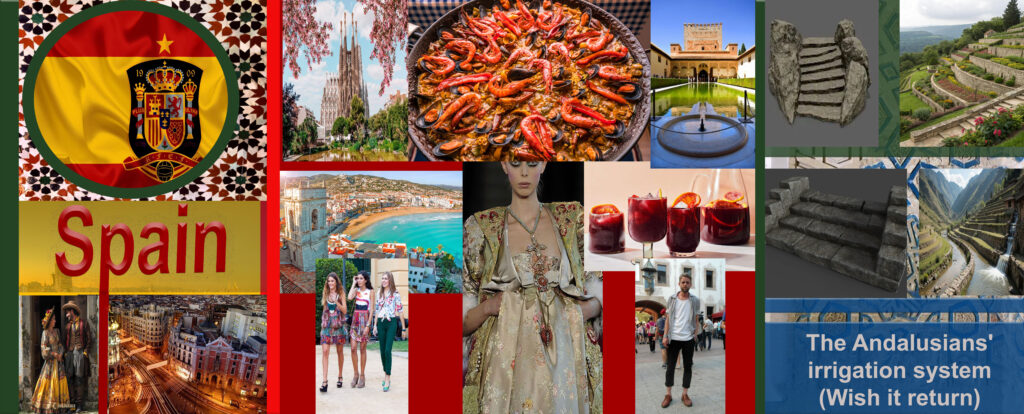
The Andalusians' irrigation system (Wish it return)
The stone terraces on mountaintops, flanked by concrete blocks on either side, provide a continuous, open-source water flow from below, allowing water to cascade down the steps. This system was used in ancient Andalusia for irrigation.
The terraced water management system (agricultural terraces or terraced irrigation systems) in Andalusia is considered one of the most ingenious inventions of Muslim engineers and farmers. It is known, both architecturally and historically, as the “Acequias y Terrazas / Bancales” system.
The Andalusians
adopted this system to manage water and utilize the mountainous terrain and slopes (such as the Alpujarras, Sierra Nevada, and eastern Andalusia in Murcia and Valencia) in a sustainable and equitable manner.
- How does the terraced system work from top to bottom? The system relies on the physical principles of simplicity and gravity, where water flows from the highest point of the slope and passes through tiered levels to meet all needs:
The Largest Source (Highest Point)
Water is collected from mountain springs, snowmelt, or raised from rivers using a waterwheel (noria) to a raised main reservoir called the “Alberca.”
First Level (Highest) – Domestic Use and Drinking
Water flows from the Alberca through stone or earthen channels called “Acequia.”
The highest level is designated for clean drinking water for humans, and for the fountains in homes and mosques.
Second Level (Middle) – Watering Animals and Birds (Troughs and Watering Places):
As the Acequia descends to the next level, the water passes over stone troughs designated for livestock and animals to drink from, called “Mashrab” or “Trough” (Morter/Abrevadero).
The design of the basins ensures a surplus that automatically overflows to the lower level without waste, and level edges are left for birds and poultry to drink from.
Third (Lowest) Level – Agricultural Terraces (Bancales)
Excess water flows down to terraces built as stepped stone platforms against the mountain walls (preventing soil erosion).
Water is distributed among the crops according to a precise timing system called “watering” or “water clock,” irrigating the land from the highest terrace to the lowest in sequence.
Now, The System Benefits
Sustainability and Filtration
The earthen surfaces of the terraces reabsorb excess water to replenish groundwater (a process historically known as “water farming” or “Imbibición”).
Reuse (Cascading use)
The same quantity of water is utilized multiple times before it reaches the soil.
Erosion Prevention
The terraces protect agricultural soil from erosion caused by rain and flash floods.
The Security Situation in Spain
For Local Affairs
Spain’s local security affairs are managed through a decentralized system that includes
The National Police Corps
The Civil Guard
The regional police forces
The municipal police
Each force has its specific role and jurisdiction, contributing to the country’s layered policing system. The National Police Corps handles urban policing, criminal investigations, public order, and immigration control, while the Civil Guard focuses on rural policing, traffic on interurban roads, border security, and environmental crimes. Regional police forces manage local crimes, traffic, and emergencies while coordinating with national bodies on serious offenses like terrorism and organized crime. Municipal police handle traffic, parking, and minor urban disturbances but lack authority for major investigations.
Spain’s law enforcement has demonstrated effectiveness in
1- Disrupting drug trafficking networks and terrorist cells, supported by specialized units and international cooperation
2- low organized crime penetration compared to European peers.
However,
The isolated high-profile corruption cases have exposed vulnerabilities in internal oversight, though systemic graft remains limited and prosecutorial responses robust.
For External Affairs
Their strategy aims to position Spain as a key global player committed to peace, security, justice, and inclusive growth.
For 2025-2028 Spain’s foreign action strategy
Emphasizes the need to adapt to a changing international order. The strategy focuses on three key pillars:
1- A more autonomous and sovereign Europe
2- A committed Spain, and a Spain that builds peace and security.
3- The importance of multilateralism, European integration, and the defense of national interests and values such as democracy, human rights, and sustainable development.
Also,
ensure that Spain occupies a position in the world that enables its citizens to fulfill their life goals successfully. The strategy addresses the security of Spanish citizens, the need for a more autonomous and cohesive European Union, and the importance of a committed Spain in international law and defense of human rights.
The strategy also addresses the security and defense challenges facing Spain in the current geopolitical context
highlighting the need for strategic autonomy and the importance of a strong European Union. It emphasizes the need for a collective project and a shared vision for the future by everyone and for everyone.