


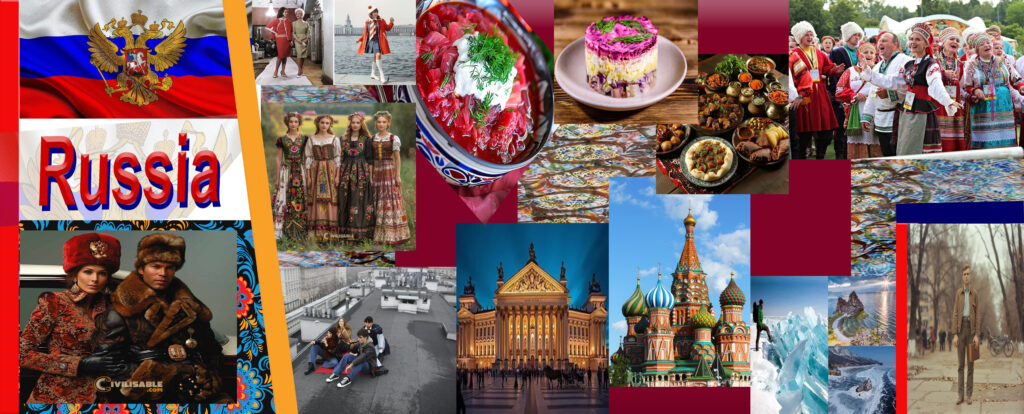
Russia is the largest country in the world
The Capital
Moscow is the capital and largest city of Russia, standing on the Moskva River in Central Russia. Moscow is among the world’s largest cities, being the most populous city entirely in Europe, the largest urban and metropolitan area in Europe, and the largest city by land area on the European continent
The Official Language
Russian
Of all the languages of Russia, Russian, the most widely spoken language, is the only official language at the national level. There are 25 other official languages, which are used in different regions of Russia.
The Official Religion
Russia does not have an official state religion
but Orthodox Christianity is the dominant and culturally privileged faith. While the Russian Constitution guarantees freedom of religion and conscience for all citizens, it also acknowledges the historical and cultural significance of Orthodox Christianity, along with respect for Islam, Buddhism, Judaism, and other traditional religions
The Location
Did you know that Russia has been classified as one of three continents, according to different definitions?
Did you know that there is what is called the dividing line between Europe and Asia?
It is not always easy to determine the dividing lines between continents. For example, Australia is considered a continent by most people, but it is an island, so it is easy to determine its beginning and end at the edge of the water. For those who consider North and South America to be two separate continents, rather than one, they generally agree that the border between Panama and Colombia is the dividing line. However, the situation between Europe and Asia is different, especially in southern Russia. For example, there are many disagreements about whether Azerbaijan, Armenia, and Georgia are part of Europe or Asia, this border between Europe and Asia, in most of the areas where this line crosses Russian territory, is simply defined by the Ural Mountains. This mountain range is about 1,600 miles long and 95 miles wide, with peaks reaching 6,217 feet, and generally runs from north to south across Russia, extending into Kazakhstan. Therefore, the most common answer to the question is that Russia lies in both Europe and Asia. Using this dividing line, approximately
8 million square miles of Russian land are in Asia
3 million in Europe
Based on this scale, Russia is considered more of an Asian country than a European one. However, it should also be noted that about 75% of Russia’s population lives within its 3 million square miles.
The Ural Mountains and the Ural River
Form the boundary between the continents of Asia and Europe. Therefore, since the Russian Federation currently straddles both continents, it is considered part of both Europe and Asia.
The Total Area
It is covering an area of more than 17 million square kilometers (6.6 million square miles) Its 7 million square miles stretch from its border with Norway to its border with North Korea.
The Famous Cuisines in Russia
Russian cuisine is a diverse collection of dishes and cooking traditions that reflect the country’s vast and multi-ethnic expanse. It includes influences from various regions such as Northeast European/Baltic, Caucasian, Central Asian, Siberian, East Asian, and Middle Eastern. Some of the most famous dishes in Russian cuisine include
Pelmeni
A national dish of Russia, pelmeni are bite-sized dumplings with various fillings, often served with sour cream.
Borscht
A traditional soup made with beetroot, cabbage, potato, onion, carrot, and tomato paste, often served with sour cream.
Shashlik
A Central and West Asian barbecue consisting of marinated, skewered, and grilled chunks of meat, typically served with vegetables.
Pirozhki
Yeast dough buns filled with a variety of ingredients, enjoyed as a snack or meal.
Khychin
A traditional filled flatbread from the regions of Kabardino-Balkaria and Karachay-Cherkessia, filled with boiled potatoes, cheese, or meat.
Back to History:(Russian Empire)
Why Russia called “The Third Rome”? Do you Know anything about it?
It’s said that Moscow is nicknamed “The Third Rome” based on the history of the collapse of the first and second Rome.
In the 13th century
Russia began as a relatively small state known as Muscovy, with Moscow as its capital. Its borders gradually expanded. By 1505, under Grand Duke Ivan III, it had made significant territorial gains.
During his reign, the territory of the Grand Duchy of Moscow tripled.
By the end of his reign, Ivan the Great had consolidated his power over all of Russia. He is therefore often referred to as the first Tsar of Russia, although Ivan IV was the first Russian ruler to officially hold that title. Ivan IV
who ruled Russia from 1547 to 1584
Expanded Russian territory beyond the Ural Mountains, reaching into north-central Asia and south to the Caspian Sea. He also radically and ruthlessly concentrated power in his own hands and for the benefit of the monarchy, punishing anyone who challenged his authority in the slightest way. For this reason, he was often called Ivan the Terrible.
The 17th century
Saw further expansion under the Russian tsars, with the country stretching to its present geographical size, from Europe to the Pacific Ocean.
In 1809,
Alexander I successfully wrested Finland from the Swedes and captured Bessarabia (present-day Moldova) from the Ottomans.
In 1812
Alexander I led the successful Russian campaign against Napoleon’s invasion.
The Russians ultimately drove the French emperor’s forces back to the gates of Paris. For this, Alexander I was dubbed the “Savior of Europe.”
In a strategic move,
Peter the Great sought to modernize Russia along Western lines and establish it as a legitimate power in Europe. To achieve this, he embarked on the annexation of new territories, with a particular focus on gaining access to the seas. He launched successful military campaigns against the Ottoman Empire to the south and the Scandinavian states of Sweden and Denmark to the north, aiming to reach the Black Sea and the Baltic Sea, respectively. Peter the Great also founded a new city on the Baltic Sea, which he named Saint Petersburg, and which became the new capital of the Russian Empire. Furthermore, he implemented sweeping reforms in the Russian government, drawing inspiration from the latest Western models.
Following the Napoleonic Wars, Russia’s power began to decline
Although the empire managed to conquer more territory in the Caucasus and Central Asia during the 19th century, it lagged behind the rest of Europe economically and technologically. Meanwhile, other European powers experienced rapid growth thanks to the Industrial Revolution, maritime trade, and the exploitation of overseas colonies. Some tsars attempted reforms aimed at modernizing the Russian Empire, such as the abolition of serfdom in 1861, but these efforts were insufficient to revive the empire.
In the Russo-Japanese War (1904–1905),
The Empire suffered a crushing defeat as the Japanese seized Russian territory in the southern part of Sakhalin Island in the Far East.
In 1905,
An attempt to petition the Tsar for reforms was met with brutal repression, resulting in the deaths of hundreds.
In the early years of the 20th century,
The Russian Empire, ruled by Tsar Nicholas II (1894–1917), faced growing internal unrest from all segments of society. Peasants, the working class, the middle class, and nationalist movements sought radical change on issues such as land redistribution, workers’ rights, and political representation.
In 1905,
The Tsar survived the first Russian Revolution, but his failure to deliver on his promises of reform led to a second revolution in March 1917 and his forced abdication.
In November 1917,
A third revolution, the Bolshevik Revolution, erupted, establishing a new Soviet government under Vladimir Lenin, who, after his victory in the Russian Civil War, created the world’s first communist state. The suffering of tens of millions during these decades of turmoil was a heavy price to pay for the new regime, which proved no less repressive than its predecessor. This collection of articles, photographs, and videos explores this turbulent period of revolutions, reforms, and repression.
In November 1917,
The Bolsheviks exploited the Russian people’s discontent and the provisional government’s incompetence to seize power. A bitter civil war ensued, which the Bolsheviks ultimately won. After defeating their enemies, the Bolsheviks proclaimed the Union of Soviet Socialist Republics, also known as the Soviet Union. Thus, the Russian Empire came to an end.
In 1918
The Soviet Union emerged and restored Moscow as the capital. However, during the transition to the current government, initially led by Boris Yeltsin, Russia experienced a significant decrease in its territory. Former territories such as Ukraine and Belarus are now independent states.
In the early 20th century
At this time, two main opposition movements emerged. The first was the Menshevik movement, which called for moderate liberal reforms in the Russian government and society. The second was a radical communist faction known as the Bolsheviks, led by Vladimir Lenin.
World War I
Was the final blow to the Russian Empire. Russia had been fighting alongside the Allies against Germany, Austria-Hungary, and the Ottoman Empire. The Russian war effort suffered a disastrous defeat, exacerbating popular discontent. Food and fuel became increasingly scarce, and inflation soared. These harsh conditions ultimately led to a popular revolution
Does Russia seeking to restore its former empire? Only time, and perhaps future generations, will tell
Russia’s Population (190 Ethnic Groups)
The country is characterized by its diversity and complexity, comprising more than 190 ethnic groups. Historical population movements have impacted many indigenous populations, and the effects of 19th-century territorial expansions are still felt among displaced communities, such as the Circassians who sought refuge in the Ottoman Empire. Slavs constitute the majority of the population, concentrated mainly in the western regions. However, the country also has a significant representation of Mongol and Turkic origins. Ethnic minorities include Tatars, Bashkirs, Chuvash, and Chechens. In contemporary Russia, a blend of European and Asian cultural influences is clearly evident. While ethnic Russians make up the majority of the population, they are only one of many groups within the Russian Federation. Some, such as the Karelians, Mordovians, and Udmurts, share European roots with ethnic Russians. In contrast, groups like the Buryats and Yakuts, who are mainly found in Eastern Siberia, have Asian origins. The Tatars, the largest minority group, are a Turkic-speaking community whose roots trace back to present-day Mongolia. Russia’s rich and diverse cultural expressions are evident in literature, ballet, painting, and classical music, and the country’s influence on chess is legendary. It’s important to remember that a large number of diverse ethnic groups live in a strip of land stretching eastward to the Pacific Ocean. Culturally, this diversity indicates a vast number of ethnicities and their traditions coexisting within a single nation. Overall, the country’s borders have undergone significant changes in the recent and distant past, and the future may hold further shifts.
The Most prominent Landmarks
The Kremlin in Moscow
An iconic fortress and UNESCO World Heritage Site
Nestled in the heart of Moscow, Russia lies The Moscow Kremlin – a historic fortress that houses an array of famous landmarks such as the Armoury Chamber and Ivan The Great Bell Tower. As one of Russia’s must-see attractions, it has been the seat of power for Russian leaders since the 14th century and was declared a UNESCO World Heritage Site in 1990. the visitors can explore its stunning architecture, museums, and galleries to gain insight into Russia’s rich history and culture. With its fascinating past, The Moscow Kremlin is undoubtedly one of Russia’s most iconic symbols that deserves a spot on any travel itinerary.
St. Basil’s Cathedral: A Symbol Of Russia’s Rich History
Located in Moscow’s Red Square, St. Basil’s Cathedral is an iconic and colorful architectural masterpiece built in the 16th century that represents the rich history of Russia. This landmark served as a church, museum, and symbol of national pride because of its unique architecture featuring domes of various shapes and colors.
Bolshoi Theatre: A World-Renowned Cultural Landmark
The Bolshoi Theatre in Russia is not just any cultural landmark; it’s an iconic must-see attraction. Founded in 1776 by Prince Pyotr Urusov and Michael Maddox, this theatrical masterpiece underwent recent renovations to restore its former glory, and it stands tall in Moscow’s city center near the famous Red Square and Kremlin.
Lake Baikal: The Deepest And Oldest Lake In The World
Lake Baikal’s breathtaking beauty lies in its crystal-clear waters surrounded by stunning scenery in Siberia. Its unique ecosystem is home to over 3,500 species of plants and animals that cannot be found anywhere else on Earth.
The Fashion
The style of Traddition Russia clothes
Sarafan and Kokoshnik
The sarafan is a long, sleeveless dress worn by Russian women, usually over a blouse with floral patterns. The kokoshnik, an ornate headdress with embroidery, beads, and pearls, complements the sarafan. Both are key to Russian folk fashion and are worn at festivals.
Rubakha and Kosovorotka
The Rubakha is a classic men’s shirt made from linen or cotton, with embroidered collar and cuffs. The Kosovorotka, a shirt buttoned on one side, was traditionally worn by Russian peasants. These styles are featured in cultural events.
Shuba (Fur Coat)
The shuba, or fur coat, is essential in Russian clothing due to the cold climate. Made from sable, mink, or fox fur, it has traditionally symbolized wealth and remains popular in cold areas.
Valenki and Lapti
Valenki are felt boots known for warmth, while lapti are woven shoes from birch bark or bast. Though less common now, these items are still closely associated with Russian Costumes.
The Luxury and Opulence Styles
In Russia, rich people wear fancy clothes with top brands and luxury materials to show off, especially in Moscow and St. Petersburg.
Streetwear and Urban Chic
Russian streetwear has gained popularity, especially among younger people, influenced by global fashion trends. Designers like Gosha Rubchinskiy have established Russia as an important player in this style.
Soviet Nostalgia
Some streetwear brands use Soviet-style jackets and bold logos for a retro look.
Sportswear
Tracksuits from Adidas and Puma are popular, often with trendy sneakers.
Logomania
Clothes with big brand logos are fashionable in cities, showing off brand status.
Do's and Don'ts in Russia
Do’s
If anyone elderly is present
Direct your attention and respect towards them.
If a Russian requests a favor
it’s worthwhile making a genuine effort to fulfil it. Such requests signify the level of personal trust they have placed in you.
Showcasing your family ties and commitment to these relationships can earn admiration among Russians.
Those who value close-knit families may view Western family practices as neglectful, like placing elderly parents in care homes. Consider mentioning positive aspects of your family life to demonstrate your closeness.
When given the opportunity, provide input and advice directly, expressing your ideas with confidence. Delicately posing advice as suggestions may result in them being overlooked or not taken seriously.
Don’ts
Avoid critiquing or offering your opinion on Russia
its politics or the president unless you are well-informed. Russians often find that Westerners have limited knowledge of the history and contextual circumstances that have contributed to certain situations. Thus, while they may agree with aspects of your argument, they can find it patronising.
Avoid mentioning past failures of the Soviet Union or the Russian State
Conversations around communism are generally acceptable, but straight criticism is unlikely to be appreciated. Similarly, respect any tributes to Soviet achievements.
Avoid discussing Russia’s involvement in wars and other military interventions.
Many people share the Russian government’s official account of events, viewing the country’s participation in conflicts as necessary defensive actions against aggressive neighbours
Do not make jokes about Russians
being drunks or women being mail-order brides for foreign men. Such comments can become insulting if delivered insensitively or too often.
The External Security Relations
1- The Threat of Russia to Ukraine, Bulgaria, the European Union, and European NATO countries
A 2025 State Intelligence Agency report, It confirmed that Russia remains the primary external security threat to Bulgaria, the European Union, and European NATO countries
The intelligence and conduct special intelligence operations
for the early identification of risks and threats to national and allied security and the constitutional order.
Among the main areas on which the SIA’s operational intelligence work focused in 2025 were
Russia’s military aggression against Ukraine and its impact on the Black Sea and Caucasus regions
The policies of the Balkan countries towards Bulgaria
issues concerning the Western Balkans, illegal migration, drug trafficking, terrorism, organized crime, hybrid operations, cyber threats, and economic and energy security.
According to the SIA’s assessment
The efforts to find opportunities for a settlement of the conflict in Ukraine did not lead to any change in the positions of Moscow and Kyiv. The Kremlin remained uninterested in a temporary ceasefire until it had achieved a greater share of its declared objectives, while Russian hybrid activities were also aimed at portraying the European Union as an obstacle to a possible agreement to end the war.
2-The China-Russia nexus and European security
“China will work with Russia to shoulder the special responsibility as major countries of the world”.
So declared Chinese leader Xi Jinping in May 2025 as he marked the 80th anniversary of the end of the second world war, alongside Vladimir Putin in Moscow. Such claims might provoke mirthless laughter in Ukraine and across Europe. Nevertheless, more than three years on from Russia’s all-out invasion of Ukraine, the Chinese leader’s remarks represent a continued expression of support from the senior to the junior partner. It is doubtful, indeed entirely improbable, that Russia could have maintained even its slow rate of progress on the battlefield without support from China.
The policymakers to consider how China might respond if Russia wins, loses or experiences neither clear victory or defeat
China and Russia: The two leaders have met dozens of times as of May 2024
Russian sources claimed that Putin and Xi had met in person more than 40 times. Xi has visited Russia more than any other country, a development in line with a broader trend of Russia as the most visited destination for the most senior Chinese leaders (including the Soviet Union previously). They have also had multiple phone calls and meetings in multilateral settings, such as within the Shanghai Cooperation Organisation (SCO) and BRICS framework.
China derives considerable benefits from a weakened but stable Russia
one increasingly dependent on Beijing for economic markets technological alternatives and diplomatic cover.
3- The crisis processes in the Middle East
The Middle East is changing under the influence of Israel’s new, far more militant course
upon which it embarked following the terrorist attacks of October 7, 2023. Prime Minister Benjamin Netanyahu’s government has become determined to eliminate the enemies that surround it, eliciting major concerns in most of the region’s states. Those concerns reached a new level after the Israeli strike on Hamas leaders in Qatar in September, which was unanimously condemned by the Gulf states. the reverberations from these changes in the Middle East have altered Western perceptions of the region. Criticism of Israel’s actions has led to a wave of leading EU countries officially recognizing Palestine and even to the imposition of targeted European sanctions against Israeli individuals. As a result, the Israeli leadership is beginning to assume that the country will not be on good terms with much of the West for a long time to come. Even if the Gaza peace agreement is fully implemented, Israel will continue to fight in Lebanon and Syria, and with Iran.
The internal instability, coupled with constant Israeli attacks
Has convinced the Syrian leadership that for now, it needs Moscow as a counterweight to the Israeli army. the instability in the Middle East also opens up new opportunities for Russia to recruit experienced fighters as mercenaries, particularly from the region’s poorer countries.