


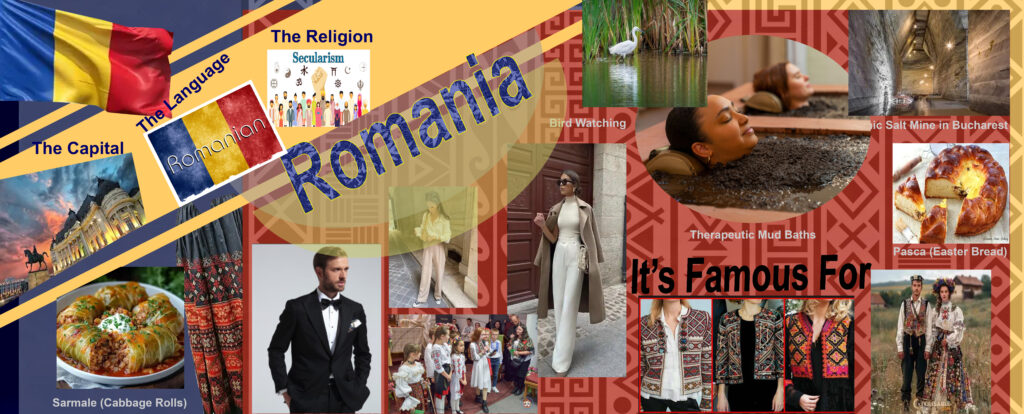
It’s Capital
Bucharest
Bucharest (Romanian: București [bukuˈreʃtʲ] ⓘ) is the capital and largest city of Romania. This major metropolis is situated on the Dâmbovița River in southeastern Romania. With an official population of approximately 1.71 million, within a greater metropolitan area of 2.31 million, Bucharest is a major cultural, political, and economic center, the seat of the government, and the capital of the Muntenia region, Ilfov County.
It’s Located at
Romania is located in Europe, specifically at the crossroads of Central, Eastern, and Southeastern Europe. It is bordered by several countries: Ukraine to the north and east, Moldova to the east, Bulgaria to the south, Serbia to the southwest, Hungary to the west, and the Black Sea to the southeast
It’s Etymology
Romania derives from the local name for Romanian (Romanian: român), which in turn derives from Latin romanus, meaning “Roman” or “of Rome”.[9] This ethnonym for Romanians is first attested in the sixteenth century by Italian humanists travelling in Transylvania, Moldavia, and Wallachia.[10][11][12] The oldest known surviving document written in Romanian that can be precisely dated, a 1521 letter known as the “Letter of Neacșu from Câmpulung”,[13] is notable for including the first documented occurrence of Romanian in a country name: Wallachia is mentioned as Țara Rumânească.
The Official and Main Language of Romania
Romanian is part of the Eastern Romance sub-branch of Romance languages
The Official Religion
It’s a Secular State with Religious Freedom
Romania is officially a secular country, meaning the government does not endorse or establish any religion, and all religious groups are treated equally under the law
Romania is Famous For
Slănic Salt Mine in Bucharest
The Slanic Salt Mine in Prahova County is the largest salt mine in Romania and Europe.
The Danube Delta
It covers a total area of about 5,800 square kilometres, of which more than 801 square kilometres are in Romania and the rest in Ukraine. It is formed by the deposition of silt by the Danube River, The delta is constantly changing – it’s advancing into the Black Sea by a few metres each year, expanding naturally.
Eforie Nord – For Wellness and Therapy
For a beach trip that doubles as a wellness retreat, head to Eforie Nord. This resort is famous for the therapeutic, mineral-rich mud from Lake Techirghiol, which has been used in spa treatments for generations. It offers a unique blend of a health destination and a classic beach vacation.
Costinești – For Youth and Endless Parties
For an unforgettable and affordable escape, look no further than Costinești, Romania’s vibrant youth capital. This destination’s allure stems from its laid-back, “anything-goes” atmosphere. Accommodations are simple guesthouses, bars are open-air, and the beach culture prioritizes enjoyment over extravagance. The dynamic energy of student festivals and live concerts attracts a youthful demographic from across Eastern Europe, creating a truly unique experience.
An Eco-Adventurer’s Activity Planner
The Romanian coast offers more than just sunbathing. the top activities for an eco-adventurer, like:
- Bird Watching
Danube Delta (Sf. Gheorghe, Sulina), Techirghiol Lake Spring & Autumn (for migration) Pelicans, cormorants, egrets, rare migratory birds Binoculars, Telephoto lens
- Kayaking/ Canoeing Danube Delta Canals, Lake Siutghiol
Labyrinthine waterways, reed forests, water lilies, fish Waterproof bag, Hat
- Wildlife Photography
Letea & Caraorman Forests, Sacalin Island Early Morning/Late Evening Wild horses, pelicans in flight, diverse bird colonies Tripod, Telephoto lens
- Exploring Ancient Ruins
Constanța, Histria Citadel, Callatis (Mangalia) Greek & Roman city remains, mosaics, defensive walls, Comfortable walking shoes
- Therapeutic Mud Baths
Lake Techirghiol (Eforie Nord), Lake Nuntași June – September Natural spa treatments, mineral-rich sapropelic mud- Old swimsuit
Famous Cousin
Romanian cuisine is rich and diverse, featuring popular dishes like
Sarmale (Cabbage Rolls)
Sarmale is often considered Romania’s national dish. It consists of minced meat (usually pork) mixed with rice and spices, wrapped in fermented cabbage leaves. The rolls are then slow-cooked in a tomato-based sauce, resulting in a savory and comforting dish. Sarmale is commonly served during festive occasions, such as Christmas and weddings, and can also be made with vegetarian fillings
Mămăligă (Polenta)
Mămăligă is a staple side dish made from cornmeal boiled in water or milk, similar to polenta. It can be served soft and creamy or allowed to set and sliced. Mămăligă is often enjoyed with Sarmale or topped with sour cream and cheese, making it a versatile accompaniment to many Romanian meals
Ciorbă de Burta (Beef Tripe Soup)
Ciorbă de Burta is a traditional sour soup made from beef tripe, flavored with vinegar, sour cream, and garlic. It is often served as a hearty starter and is known for its unique taste and texture
Cozonac (Sweet Bread)
Cozonac is a traditional Romanian sweet bread, often filled with nuts, cocoa, or poppy seeds. It is typically prepared for holidays and special occasions, making it a beloved dessert in Romanian households
Pasca (Easter Bread)
Pasca is a sweet cheese bread traditionally made for Easter celebrations. It combines cheese, raisins, and a hint of vanilla, creating a rich and flavorful dessert that holds cultural significance during the holiday
The Clothing
The Famous Tradition Clothes
Bundiță (Sheepskin Vest)
The bundiță is a sleeveless vest made from sheepskin, often worn over the ie blouse. It features richly embroidered details and sometimes includes fur trim for extra warmth. This vest was traditionally worn in Romania’s rural regions, particularly during the colder months. Today, it continues to be a part of ceremonial dress, symbolizing the rugged yet beautiful Romanian countryside.
Catrința (Woolen Skirt)
The catrința is a wrap-around woolen skirt, typically worn over a white underskirt. The fabric is often adorned with colorful embroidery or stripes, depending on the region. Tied at the waist with a cord, the catrința was once an everyday garment but is now mostly worn for festivals or special occasions. Its heavy, durable fabric made it ideal for Romania’s harsh winters.
Ie (Embroidered Blouse)
The “ie” is the quintessential piece of Romanian women’s clothing, known for its delicate embroidery. Made from lightweight fabrics like cotton or linen, the blouse features intricate patterns in bold colors around the neckline and sleeves. The embroidery often tells a story, with motifs symbolizing nature, fertility, or protection. Worn both casually and for formal events, the ie is a timeless symbol of Romanian culture.
Second: The Contemporary Urban Style
Casual Streetwear: Like many European countries, Romania has adopted global fashion trends. Urban youth favor casual streetwear styles, including jeans, leather jackets, sneakers, and hoodies. Big brands like Zara, H&M, and Nike are popular in Bucharest and Cluj-Napoca, improving the Romanian clothing scene.
Chic and Minimalist Styles
Romanian urban fashion features sleek, minimalist aesthetics. Many professionals wear all-black or all-white outfits, fitted blazers, and simple, stylish accessories. Neutral tones like black, gray, white, and beige are prevalent in these looks.
Evening Wear
Romanian fashion enthusiasts enjoy elegant evening wear for formal events. Dresses with flowing lines, tailored suits, and stylish accessories are common. Designers mix modern styles with Romanian patterns for unique evening wear that reflects the country’s heritage.
Famous DOs and DONT’s in Romania
Language Barrier
While many Romanians speak English, especially in tourist areas and among the younger population, it’s still possible to encounter a language barrier. Learning a few basic Romanian phrases like ‘salut’ (hello), ‘mulțumesc’ (thank you), and ‘da’ (yes) can go a long way in showing respect for the culture and people. When communicating with locals, it’s essential to be patient and polite, and to ask for clarification if necessary.
Non-verbal communication
is also important in Romania. For example, direct eye contact is considered a sign of respect and sincerity, and it’s customary to maintain eye contact when interacting with someone.
Respect personal space
And avoid standing too close to someone as this can be seen as invasive or aggressive.
Be mindful of body language and gestures
For example, it’s customary to use the right hand when giving or receiving something, as the left hand is considered unclean in some cultures. By being aware of these cultural nuances, visitors can avoid unintentionally offending someone and create a positive impression.
Dress Code
When visiting Romania, it’s essential to respect the local dress code, especially when attending cultural events or visiting churches and monasteries. Modest clothing that covers the shoulders and knees is recommended, and it’s best to avoid revealing or provocative clothing.
Respect local customs and traditions
For example, when visiting a church or monastery, it’s customary to light a candle and make a small donation. By showing respect for these customs, visitors can create a positive impression and avoid unintentionally offending someone.
Romanians tend to value honesty and sincerity
By being aware of these cultural differences, visitors can avoid misunderstandings and create a positive impression.
Be mindful of safety and security
As with any country, there are areas that are considered safer than others, and it’s always a good idea to take necessary precautions to protect yourself and your belongings.
The Internal/External Security Situation in Romania
Romania Travel Advisory
Crime
The U.S. Department of State has assessed Bucharest as being a LOW-threat environment for crime directed at or affecting official U.S. government interests. The U.S. Department of State has not included a crime “C” indicator on the Travel Advisory for Romania.
Most crimes against visitors are limited to crimes of opportunity or scams. Robbery, pick pocketing, internet scams, and credit card fraud are the most reported crimes. Violent crime is rare. Travelers should be aware of scams involving individuals posing as plainclothes police officers, approaches of quick friendship at train/subway stations, and pickpocketing in crowded areas. Organized groups of criminals, sometimes including very young children and well-dressed young adults, operate in train stations, trains, subways, and buses.
Take care when patronizing nightclubs, which can charge exorbitant prices and be persistent in pursuing payment. Simple assaults outside of clubs are possible, especially late at night after consumption of alcohol.
The formulation of Romania’s foreign policy
objectives and a nuanced analysis of the geopolitical context are left to the often very opaque bureaucracy of the state. At the same time, the objectives of Romania’s foreign policy are not discussed in a public debate that is also open to civil society actors and academic experts.
Travelers should use ATMs located
Inside reputable banks, hotels, and shopping malls and centers. Check ATM machines for any evidence of tampering before use.
Internet romance and financial scams
Are also present in Romania. Scams are initiated through Internet postings/profiles or by unsolicited emails and letters. Scammers pose as U.S. citizens who have no one else to turn for help. Common scams include romance/online dating, money transfers, grandparent/relative targeting, lotteries, medical emergencies, police actions, and bank overpayments.
It’s known, it’s an origin and destination for human trafficking. People who become involved in human trafficking rings are usually exploited in the sex industry, agriculture, construction, domestic service, hotels, or for forced begging and theft, in Romania as well as other European countries. Extortion in the form of blackmail targeting institutions and companies has also been reported, there are no specific areas of concern in Romania. As in most parts of the world, crime occurs more frequently in populated metropolitan areas. However, these threats are not specific to any one geographical area.
Kidnapping Threat
The U.S. Department of State has not included a kidnapping “K” indicator on the Travel Advisory for Romania.
Kidnappings are uncommon, though there continue to be parental child abduction cases reported to the U.S. Embassy Bucharest.
Terrorism
The U.S. Department of State has assessed Bucharest as being a LOW-threat environment for terrorism directed at or affecting official U.S. government interests. The U.S. Department of State has not included a terrorism “T” indicator on the Travel Advisory for Romania. while there have not been recent terrorist attacks in Romania, it is not immune from the general, European terrorism risks. Romania has robust, professional, and effective security services.
Political Violence and Civil Unrest
The U.S. Department of State has assessed Bucharest as being a LOW-threat environment for political violence directed at or affecting official U.S. government interests.
The following recommendations can help which included in a Report Co – Funded by Uripian Union: trengthen public understanding of Romania’s strategic role in the EU and NATO:
1- Romania sits at one of Europe’s most sensitive frontiers
yet a large share of its respondents still feels that the EU “dictates” or that NATO is “aggressive.” Authorities
2- Must know h How Romania shapes Western decision-making
for example through hosting NATO’s largest European base, shaping Black Sea policy, and influencing EU responses to Russia’s aggression. This is particularly important or younger adults and lower-education groups, who show higher scepticism toward Euro-Atlantic institutions and a stronger tendency to view democratic governance as ineffective.
3- Romania’s real leverage can also help counter anti-system
narratives exploited by foreign malign actors. Convert high security awareness into national resilience: Respondents in Romania
4- overwhelmingly demand stronger crisis preparedness, cyber-defence, and anti disinformation efforts, and show very high trust in the armed forces. National institutions
should meet this demand by establishing permanent resilience programmes: better crisis communication, local preparedness trainings, and transparent information on
cyber threats and foreign interference. With such strong public backing, Romania can rapidly strengthen its resilience against hybrid threats.
5- Why the Communicate about the war in Ukraine through clear national-interest benefits: Public support for Ukraine is mixed – while most back its right to defend itself, nearly half support territorial concessions. Strategic communication should emphasise how
Ukraine’s resilience directly protects Romania: preventing spillover of conflict and safeguarding regional trade and energy routes. This clarification is particularly relevant or younger adults, who express more cautious views about military assistance and its consequences.
6- Invest in digital literacy, and counter-conspiracy measures: Romania has one of the region’s highest beliefs in conspiracy theories and lowest consumption of standard mainstream newspapers. Authorities and civil society should expand support for reliable journalism, fact-based public communication, and digital literacy initiatives, specially in high-risk groups including older and rural population to reduce the
influence of conspiracies and foreign malign influence.
Why the Black Sea is still a Russian lake and why Romania’s policies make it look smaller and weaker than it really is
The Black Sea remains a contested area due to Russia’s strategic interests and actions, particularly following the annexation of Crimea in 2014 and the full – scale invasion of Ukraine in 2022. These events have heightened the region’s geopolitical tensions, especially with Romania, which has been a NATO ally and a key player in the Black Sea’s security. Romania’s defense policy and its strategic position in the region have been shaped by these developments, leading to a complex balance of interests and security concerns.
Also, must considered and Understanding Russia’s Black Sea strategy and what the relationship of Türkiye in this situation?
The understanding the patterns of consistency and adaptation in Moscow’s Black Sea posture is crucial for predicting its future strategic behavior. Russia’s continued use of hybrid and total warfare in the Black Sea, if successful, would have catastrophic consequences for the entire region, Ensuring that Ukraine retains control of Odessa and its adjacent coastline is essential for Black Sea security. Any future ceasefire or peace agreement must include provisions for long-term deterrence against any renewed Russian attempts to cut off Ukraine’s access to the Black Sea. Such a move would not only undermine Ukraine’s economic viability but also diminish its broader strategic importance. Ankara’s adherence to the Montreux Convention, which prohibits warships from entering the Black Sea during wartime, has significantly impacted Russia’s ambitions. Therefore, Türkiye will remain a pivotal player in the Black Sea and a vital partner for the West, due to the country’s control of the Turkish Straits, its possession of the longest coastline in the region, and its significant geopolitical weight.
Finally, We must mention: Russia’s relations with Romania
What is the Future Expansionist Agenda of Russia? And What is the nightmare scenario’ for Romania?
Russia is actively seeking to project influence among NATO’s Black Sea littoral states, with the aim of diminishing the alliance’s presence in the region and disrupting coordination among its coastal allies.
Of the three NATO littoral states in the Black Sea, Russia perceives Romania as a particular challenge to its position. This perception stems from Romania’s strong commitment to NATO and its persistent efforts to enhance the alliance’s presence in the region. Bucharest has actively pushed to elevate Black Sea security as a strategic priority for the US, NATO and the EU, advocating for a ‘comprehensive approach’ that extends beyond military considerations to include economic connectivity, environmental and energy security, and resilience-building. Since the annexation of Crimea – and especially following the full-scale invasion of Ukraine – Romania’s threat perception of Russia has intensified. The proximity of active military operations and concerns over a potential spillover, whether through an accidental attack on Romanian territory (for example, the incident with the Russian drone that struck a Danube port), the flow of refugees, or a deliberate escalation, have heightened Bucharest’s security anxieties. Russia’s attempts at the start of the invasion to capture Snake Island and destroy the Zatoka Bridge (the only road link between Romania and Odesa) have reinforced fears that Moscow remains intent on capturing Odesa. If successful, this could enable Russia to reconnect with Transnistria (the landlocked region that is trying to break away from Moldova), creating a direct land border with Romania – an increasingly concerning prospect for Bucharest. While Russia’s capture of Odesa appears unlikely for the time being, Bucharest is worried about such a prospect, describing it as a ‘nightmare scenario’ for Romania.
Moscow, in turn, is also suspicious of what it views as Romania’s expansionist agenda – specifically, its alleged aspirations to incorporate Moldova (potentially including Transnistria) and extend its influence into Ukraine’s Odesa and Chernivtsi regions by leveraging Romanian-speaking minorities. Although the idea of Moldovan unification with Romania has largely lost traction – particularly after Romania acceded to the EU and NATO – Russia continues to invoke the myth of ‘Greater Romania’ as a persistent strategic objective of Bucharest. As one Russian publication put it, ‘Russia stands in the way of Romania pursuing its expansionist agenda’. Accordingly, Moscow views Bucharest’s close cooperation with Washington and its active role in Black Sea security initiatives as part of a strategy aimed at advancing Romanian interests at Russia’s expense.
Dear Reader, maybe you Always Well and safe, Thanks for reading…
Some of the Main Resources is
Public Attitudes and Security Perceptions in Romania – Resilience and Vulnerabilities in 2025 EN.pdf