


The Security in Libya by
Abdul moneam mohammed abdul latif Essadi
European studies researcher, international cooperation expert
It's Located in
Northern Africa
The Capital
Benghazi
The Official Religion
Islam
The Official Language
Arabic
The official language of Libya is Modern Standard Arabic. Most residents speak one of the varieties of Arabic as a first language, most prominently Libyan Arabic, but also Egyptian Arabic and Tunisian Arabic.
The Famous Landmarks
Leptis Magna
Leptis Magna is one of the best-preserved ancient Roman cities in the world and one of the most famous landmarks in Libya
UNESCO World Heritage was founded by the Phoenicians and later became part of the Roman Empire, flourishing under the reign of Emperor Septimius Severus, who was born in the city. The sprawling ruins of Leptis Magna include a grand basilica, a theater, a marketplace, and stunning mosaics, showcasing the grandeur of Roman architecture and urban planning.
Acacus Mountains (Tadrart Acacus)
The Acacus Mountains, also known as Tadrart Acacus, are a striking desert mountain range located in southwestern Libya, near the border with Algeria. This UNESCO World Heritage Site is famous for its prehistoric rock art, which dates back more than 12,000 years. The rock paintings and carvings depict scenes of wildlife, human figures, and daily life from a time when the Sahara was a lush and fertile region. The dramatic landscapes of towering sand dunes, sandstone formations, and hidden valleys make the Acacus Mountains a paradise for adventure seekers and history buffs alike.
Tripoli Medina
The Medina (Old Town) of Tripoli is a bustling center of commerce, culture, and history, offering a glimpse into Libya’s vibrant past. The narrow alleyways are lined with traditional shops selling spices, textiles, jewelry, and handmade crafts. Visitors can explore historical sites such as the Arch of Marcus Aurelius, a well-preserved Roman monument, and the Red Castle (Assaraya Alhamra), which houses the National Museum of Libya. The Medina’s architecture reflects a blend of Arab, Ottoman, and Italian influences, making it a fascinating destination for history and culture enthusiasts
Arch of Marcus Aurelius
The Arch of Marcus Aurelius is one of the most significant Roman-era monuments in Tripoli, located within the city’s historic Medina. Built in honor of Emperor Marcus Aurelius in the 2nd century AD, the arch is remarkably well-preserved and remains a popular tourist attraction. The four-sided arch is adorned with detailed carvings and inscriptions, offering a glimpse into Roman art and architecture. The arch stands as a testament to Libya’s rich history as part of the Roman Empire.
Nalut Castle
Nalut Castle is an ancient Berber fortress located in the Nafusa Mountains of western Libya. Built into the side of a mountain, the castle served as a grain storage and defensive structure for the local Berber community. The fortress’s architecture is a prime example of traditional Berber design, with interconnected storage rooms, narrow passageways, and a strategic location offering panoramic views of the surrounding desert landscape. Nalut Castle is one of the many ksour (fortified granaries) that dot the Nafusa Mountains and is a testament to the ingenuity of Berber engineering.
Sabratha
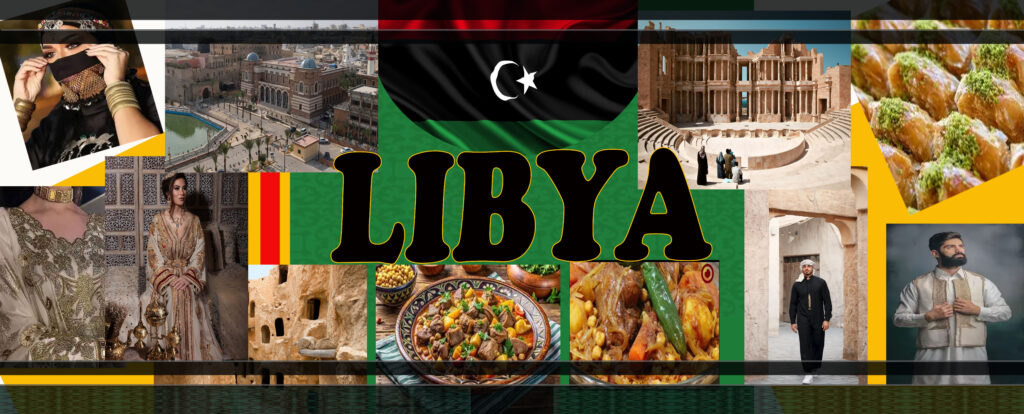
Sabratha, a third UNESCO World Heritage Site in Libya, was an ancient Phoenician trading post before becoming part of the Roman Empire. The city is famous for its magnificent Roman theater, which has been restored and remains one of the finest examples of Roman architecture in North Africa. The ruins also include temples, baths, and mosaics that provide insight into life in the ancient city. Sabratha’s location on the Mediterranean coast adds to its appeal, making it a must-see for history enthusiasts.
The Fashion in Libya
Libyan fashion is a unique blend of traditional and modern styles,
Reflecting the country’s rich cultural heritage and contemporary influences. The traditional Libyan clothing, such as the thob and the hijab, is still widely worn, particularly in rural areas. However, in urban areas, modern fashion trends have taken hold, with young people often adopting Western styles and incorporating them into their own unique looks.
Libyan fashion is also influenced by the country’s political and social history
With clothing often being used as a form of expression and protest. During the Libyan revolution, for example, many young people wore clothing with political slogans and symbols, expressing their support for the revolution and their desire for change. In recent years, there has been a growing interest in promoting Libyan fashion both domestically and internationally.
Fashion shows and events have been organized to showcase the work of Libyan designers,
And there has been a push to promote traditional Libyan fabrics and designs. Despite these efforts, the Libyan fashion industry still faces many challenges, including a lack of infrastructure and resources, as well as limited access to international markets. However, there is a growing sense of optimism among young designers and entrepreneurs, who are working to build a vibrant and sustainable fashion industry in Libya.
Libya Do's and Don'ts
Libyans are a friendly people, religion is taking an effect in their lives, generally speaking, people wear decent clothes, no shorts or miniskirts in public places.
Do carry your passport/visa on you at all times
There are many police checkpoints (both formal and informal) in Tripoli and on the roads outside of the city. One of the benefits of having tourist police is that they will handle these stops and document checks for you. If you are part of a group tour, you likely won’t even notice that most of the checks are happening! With your guides handling the interactions with police, you most likely won’t be asked to show your passport at every stop, however it does happen so be prepared.
Do dress conservatively
While you will see people dressed in western clothes in Libya, people are still dressed conservatively. Men are not wearing shorts, and women are covering their legs and arms. I personally wear a headscarf when I am in Libya as 99% of the women you see are also covering their heads. I do this to blend in and to respect the local norms and the people I work with, but would I be fine if I didn’t wear one? Yes, in all honestly as a foreigner you can dress how you want. As a tourist, you are constantly being escorted by tourist police and Libyans are not likely to start a confrontation, so in all likelihood no one is going to harass you. However, I have been told by older locals that they will feel disrespected if you are showing too much skin, and that you will draw some unwanted attention to yourself. T-shirts are okay, but it is best to show appreciation and respect by wearing long pants, for both men and women.
Do keep your voice down
After spending some time in Libya, you’ll notice that the people are very calm and quiet (which is shocking considering the amount of espresso many of them drink!). Even in the busy market of the old city, you won’t hear shopkeepers shouting at you to take a look at their wares. People might say something to you if you enter their shop, but if you say no just one time, they leave you alone – a huge contrast from the nature of many other North African markets! Of course, people still talk and laugh with their companions in restaurants, but it doesn’t reach the levels you hear in many western restaurants, and you’ll never hear someone shouting to their friend from across the room or the street. It can be easy to get carried away but try to respect the local norms by being aware of how loud you’re being. No one will shame you if you are too loud, but you might get some dirty looks! And it might just be a bit embarrassing for you and whoever you’re with.
Positive outlooks are highly valued in Libya,
If someone asks, ‘How are you?’ the correct response is ‘Thank God.’ and it’s also common to say ‘Asalam Alikom.’, which means ‘Peace be upon you.’, when you come or leave.
Women don’t shake hands with men,
It is not a good idea to speak to a woman you don’t know if you are a male.
The map of Libya is very important,
So bring a map because most of the streets don’t have signs or are marked.
When you visit someone in his house or you are invited to a Libyan house,
Don’t forget to bring presents like sweets, chocolates, etc.
Remove your shoes
When you enter Libyan’s houses.