


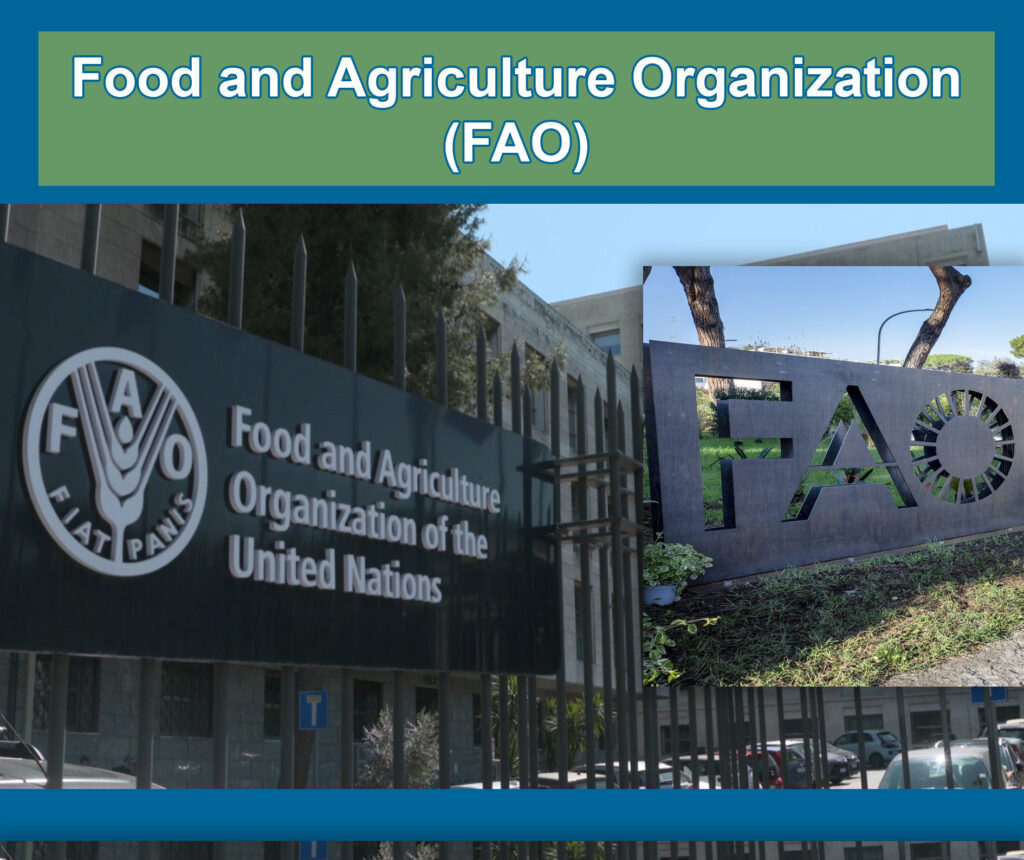
Note: FAO is one of the Family of UN Organizations
United Nations – BLOG Global Peace Let’s Talk
The Food and Agriculture Organization (FAO) is a United Nations agency that aims to combat hunger and improve global food security and poverty by developing sustainable agriculture.
Who Leads the FAO?
As of 2026, Qu Dongyu serves as Director-General of the Food and Agriculture Organization of the United Nations.
The FAO, a UN agency, works globally to combat hunger through:
- Sustainable agriculture (through legislation and national strategies)
- Agriculture-related threats and crises
- Sustainable local food systems
- Better production
- Nutrition
- Environment
- Life quality
- Forestry
- Fishery practices
- Aquaculture
- Reduce, and warn about hazards to the food chain
- Improves smallholder agriculture
- Ensuring safe food practices and standards
- Clean water
- Biodiversity
- Genetic resources
- Internal production and trade
- Ensure sustainable consumption patterns at local level
- Ensure sustainable production patterns at local level
- Increasing access to healthy diets
- Protect, restore, and promote the use of terrestrial and marine ecosystems
Where its Funding comes from?
It comes from the industrialized countries development banks, and public-private partnerships and other sources.
Where its headquarters?
Its headquarters is in Rome, Italy, with offices in more than 130 countries, employing over 11,561 staff members.
How Does the FAO Help Countries During a Food Shortage and famine?
- providing food to countries suffering from famine
- Set up sustainable food sources in those countries ((like: keep domestic food production and farm incomes up)
How Are FAO Strategies and Initiatives Developed?
developed based on global and regional challenges, such as the COVID-19 pandemic, it uses:
- Internal and external consultations
- Governing Body meetings
- Informal consultations
As an Examples: Solutions/Initiatives of FAO on the way
First: About animal diseases
Rome – Countries around the world are facing a growing threat from transboundary animal diseases (TADs), including New World Screwworm, African Swine Fever, Avian Influenza, Foot-and-Mouth Disease, and Peste des Petits Ruminants, as well as other emerging zoonotic threats such as Andes hantavirus, Ebola, and Nipah. As diseases and pests move more rapidly across borders, countries are facing increasing pressure to strengthen prevention, preparedness and response systems.
Strong prevention and preparedness remain the most effective and least costly tools for reducing the impact of animal disease outbreaks. When outbreaks exceed national capacity, FAO acts as the Provider of Last Resort, rapidly deploying expertise, coordinating the response, and mobilizing resources to sustain action when national systems are overwhelmed or other actors cannot operate.
Who is (GPP-TAD)?
As part of this effort, FAO is working with Members to develop the Global Partnership Programme for Transboundary Animal Diseases (GPP-TAD), a long-term, country-owned platform focused on prevention, early warning, preparedness, anticipatory action and rapid response. The objective is to help countries detect and contain outbreaks earlier, reduce disruptions to food production and trade, and minimize the need for costly emergency interventions.
Second: Capturing fog to make water
In Chile, a community transforms fog into a source of water to cope with water scarcity and drought
This community, located in the Fray Jorge Biosphere Reserve on the slopes of a coastal mountain range, has had to adapt to droughts and periods of prolonged water scarcity. In these areas of northern Chile, the infrequent rainfall, climate variability and pressure on traditional sources have made access to water a daily challenge. Here, many families depend on wells, or when the wells dry up, on cistern trucks for their water supply. Then came the idea of installing fog catchers, these simple structures made of mesh intercept the microdroplets that make up fog. Over the years, the community has perfected its fog catcher models, adjusting designs, materials and locations based on the region’s combined experiences. This process has allowed them to develop increasingly efficient systems adapted to local conditions; Fog catchers are as simple as they are precise. When the mist passes through the meshes, the microdroplets condense and run off into gutters. From there, the water is conveyed to storage ponds. Then, through a system of hoses, it is distributed to irrigation areas. On dry days, this constant flow makes it possible to keep crops alive and support small production cycles, since the fog catchers’ creation, the Reserve has received about 7 000 visitors, becoming a learning space for nature-based solutions.
Scaling up to combat water scarcity
This support from the FAO-GEF Land Restoration Project has made it possible to expand and refine an initiative that is today a reference in the country and in the region. The additional fog catchers implemented are expected to produce over 200 000 litres of water per year, making more water available in the spring and summer when the shortage is most critical.
Third: Sustainable value chains
Global fisheries and aquaculture production has steadily expanded in recent years, making aquatic foods one of the most widely traded products in the world. But increases in production and trade do not mean equitable distribution, growth or sharing of benefits. To achieve that, we need a transformative action. transforming the way aquatic foods are harvested, processed, marketed, traded and consumed is key to long-term economic, environmental and social sustainability. This is what FAO calls a Blue Transformation, a vision where resilient, equitable and transparent value chains lead to more opportunities for all. This page presents our projects, products and services.
If you want to be one of the employees on FAO, here is the Linke to all jobs;
Some of Links if you interest to learn mor