


GPLT: Public Relations
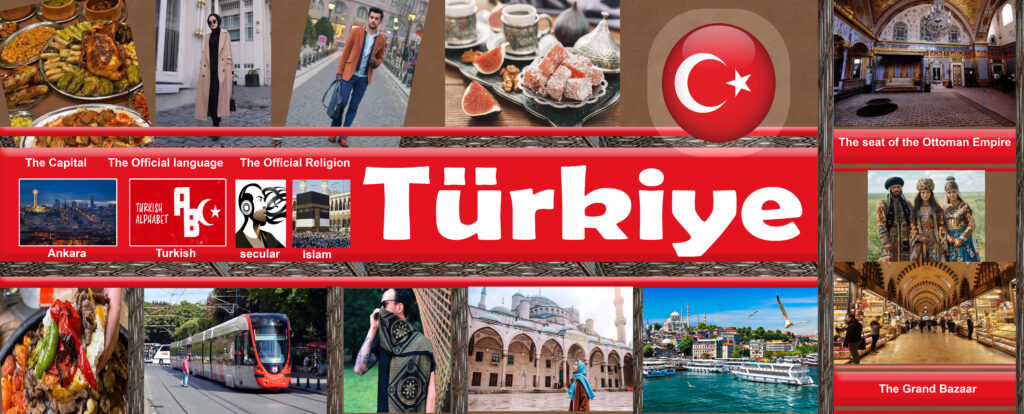
The Capital
Ankara
The Location
Turkey is in a unique geographic position, acting as a bridge between Europe and Asia. The country is at the crossroads of the Balkans, the Caucasus, the Middle East, and the eastern Mediterranean. Most of Turkey is in Asia, on the peninsula of Asia Minor, also known as Anatolia. A small portion, Turkish Thrace, is in southeastern Europe. Turkey is bounded by the Black Sea to the north, Georgia and Armenia to the northeast, Azerbaijan and Iran to the east, Iraq and Syria to the southeast, the Mediterranean and Aegean Seas to the southwest and west, and Greece and Bulgaria to the northwest. Ankara is the capital, and Istanbul is the largest city and seaport.
The Official language
Turkish language
The Official Religion
Turkey is officially a secular state with no official religion, although Islam is the predominant faith among its population.
Türkiye is Famous for
Hagia Sophia’ History, please follow this Link
https://www.pdffiller.com/s/xfRKj9il
The Bosphorus Strait
The strait that connects the Black Sea to the Sea of Marmara today was originally the Bosphorus River. The Bosphorus Strait now flows into the Bosphorus Sea. More than just a waterway, the Bosphorus Strait is famous for separating European and Asian Istanbul. Regular ferries cross the strait, transporting passengers to another continent in approximately 20 minutes.
The seat of the Ottoman Empire
In the late 13th century, Osman I established a beylik or small principality in what is now Turkey. This principality grew into the Ottoman Empire, which conquered more powerful neighbors. Stretching from the Balkans in southeastern Europe to Central Asia, Arabia, and North Africa, the Ottoman Empire was one of the largest and longest-lasting empires in history. The empire lasted until the early 20th century, ending in its abolition in 1922. Spanning more than 600 years, the empire was known for its achievements in art, literature, architecture, science, medicine, and military prowess
Grand Bazaar
True to its name, the Grand Bazaar is known as one of the largest markets in the world. With this, it offers a wide variety of goods: under its roof, it covers over 4,000 shops and welcomes almost half a million customers daily! Built in 1455, the Grand Bazaar is also one of the oldest markets; hence, it has become a historical treasure of Turkey as well.
The Clothing
In Turkey, both men and women have a wide range of clothing options available. In modern cities like Istanbul, Ankara, and Izmir, you will see a mix of Western-style clothing and traditional attire. Women’s fashion is influenced by the influx of tourists from the Middle East, and many dress in a more Western style. However, in conservative regions and during religious ceremonies, specific dress codes are observed. Men’s fashion is also influenced by the influx of tourists, with many wearing Western-style clothing. In coastal resorts, such as Antalya, Çeşme, and Bodrum, you will find a relaxed and tourist-friendly atmosphere where Western-style dress is common.
Turkish National Costume for Women
Turkish national costume for women reveals an enchanting narrative of heritage and grace. From the flowing şalvar to the regal Entari, each dress reflects tradition and elegance, mirroring the wearer’s identity and cultural heritage. throughout history, women in Turkey have cherished their attire as symbols of self-expression and societal roles. The şalvar embodies modesty and practicality, while the Entari signifies status and celebration during special occasions.
Turkish National Costume for Men
Turkish national costume for men reflects a rich legacy of heritage and masculinity. From the dignified “şalvar” to the distinguished “Cepken,” each outfit embodies a fusion of tradition and strength, representing the wearer’s identity and cultural heritage. throughout history, Turkish men have valued their clothing as symbols of heritage and societal roles. The “şalvar” epitomizes practicality and freedom of movement, while the “Cepken” exudes elegance and status, especially during ceremonial occasions.
DOs and DONT’s In Turkey
First: Dos
Steer clear of tourist resorts and explore local towns instead.
While visiting coastal resorts, one of our best tips for traveling to Turkey is to seek out more traditional destinations, if possible. You’ll gain a better understanding of Turkish traditions and people, and you might even make new friends! The country is easy to get around, so look for local towns that are easily accessible by bus and spend a day or two there.
Discover Istanbul
Istanbul straddles two continents: Asia and Europe, separated by the Bosphorus Strait and connected by bridges, ferries, and the Marmaray railway tunnel. Istanbul is a city you can’t fully explore in one visit, so if you want to see the best it has to offer, you need to plan. Istanbul boasts a rich history that perhaps surpasses any other place
Try the local cuisine
Some must-try dishes include: lahmacun (flatbread topped with minced lamb seasoned with herbs), pide (another flatbread, but this time with various fillings), doner kebab, Adana kebab (a long, spicy lamb kebab usually served with rice and salad), and mende İnemen (a breakfast dish similar to an omelet with eggs and tomatoes). And of course, the famous Turkish breakfast, also known as kahvalti. You won’t feel hungry after such a delicious meal! A hot cup of tea is served with every meal, and it’s recommended to have at least three cups and try Turkish coffee; it’s unlike anything you’ve ever tasted.
Dress modestly to avoid attracting attention
While much of Turkey has a relaxed, Westernized feel, that doesn’t mean you won’t attract attention if you dress appropriately. Although Turkey is more liberal than its Middle Eastern neighbors, it remains a conservative Muslim country, especially away from the main tourist resorts. While you can dress as you like in the resorts along the southern coast, more modest attire is recommended in other areas.
Use public transport, especially in Istanbul
You’ll save a significant amount of money by avoiding taxis and other pre-arranged transportation and opting for public transport instead. Buses are reliable, inexpensive, and will quickly get you to most cities and towns. In Istanbul, you have a variety of transport options, and you should purchase an Istanbulkart, a prepaid card, to use on all public transport.
Second: DONT’s
Don’t forget to take off your shoes at the entrance
If you’re lucky enough to be invited to someone’s home, make sure to remove your shoes at the door. This is a sign of respect, and it also reminds you that entering a home means bringing dirt and bacteria inside, where people sleep and eat. Not all homeowners will ask you to do this but do it anyway; you won’t offend anyone.
Don’t refuse food or tea when visiting someone
If you are visiting someone’s home, don’t refuse any food or tea offered to you. You may be full and not hungry but at least have some! If they ask if you are hungry and you are not, it’s fine to say so, but if they offer you food without you asking, it’s customary to accept it.
Don’t forget to pack clothes suitable for the weather
Turkey is a vast country with a diverse climate and terrain. Depending on your location, you might encounter arid desert conditions, temperate weather, freezing snow, or scorching sun. Check the weather forecast for the places you plan to visit beforehand so you aren’t surprised by sudden changes in weather while traveling. Winter weather varies from place to place.
Don’t forget the etiquette of visiting mosques
Istanbul, in particular, boasts some truly beautiful mosques, most notably the famous Blue Mosque in the Sultanahmet district. You can visit them freely, but they are closed during prayer times throughout the day, especially on Fridays. Women should cover their heads and ensure their elbows are down and their legs are covered. Mosque staff will usually offer you a shawl to drape over your shoulders or legs if they deem your attire inappropriate, but it’s always best to dress modestly from the outset. Men should wear long trousers and a shirt/T-shirt, with their shoulders covered. Everyone should remove their shoes at the entrance and avoid standing in front of worshippers. If you want to take photos, make sure to turn off the flash, and never photograph anyone praying.
Don’t let taxi drivers take you on “tourist” routes
As in any tourist destination, some taxi drivers may take you on tourist routes and ask for extra fare. This isn’t true of all taxi drivers, but some, especially in tourist resorts and even in Istanbul, do
The Internal/External Security Situation in Turkey
1- Eliminating Terrorism
This strategy in Turkey rests on three pillars
The Ministry of the Interior domestically
The Ministry of National Defense abroad
The National Intelligence Organization (MIT), which carries out intelligence and operational missions both within and outside the country’s borders. It is worth noting that this strategy emphasizes the complete neutralization of terrorist organizations without any tolerance. Therefore, reconciliation efforts do not imply a cessation of counter-terrorism operations.
2- Strengthening border security technologies
Türkiye completes security wall across 44% of land borders
Turkey has completed the construction of a security wall along 1,304 kilometers (810.27 miles) of its land border, according to the 2026 Presidential Annual Program published in the Official Gazette. The government launched this program to strengthen border control, prevent irregular migration, curb smuggling activities, and prevent the movement of potential terrorists before they reach Turkish territory. The report indicates that Turkey has designated its borders with Syria and Iran as the most dangerous areas, with these two borders together totaling 1,471 kilometers. thus, surveillance technologies are expanding along the eastern and western borders. Turkey has bolstered its border infrastructure with new watchtowers and thermal imaging systems. Work is also underway along Turkey’s borders with Greece and Bulgaria as part of the Thrace Border Physical Security Systems project, launched in 2023. Officials have completed 396 kilometers of patrol routes as part of this project.
3- The Turkish-Kurdish Peace Process Negotiations
For your knowledge, Turkey is home to nearly half of the world’s 40 million Kurds, as well as millions of other non-Turks, including Arabs. However, critics tend to blame what they perceive as the inadequate representation of non-Turks for some of the prevailing grievances and internal conflicts.
A new initiative launched by Turkish President Recep Tayyip Erdoğan and Abdullah Öcalan, the leader of the Kurdistan Workers’ Party (PKK), to end a five-decade-long conflict, holds the potential to reshape the dynamics of the Middle East.
What are the objectives of the Turkish-Kurdish peace process?
Erdoğan appears to have a set of objectives he seeks to achieve:
While the Turkish president seeks to position himself for victory in this endeavor, Iraq, Syria, and other Arab states have a vested interest in ensuring a peaceful and lasting solution.
Disarming the PKK and easing military tensions in Turkey’s relations with its southern neighbors.
Boosting economic recovery.
Improving relations with the United States and Europe before the next presidential elections scheduled for 2028.
Baghdad
keen interest inthe Turkish-Kurdish peace process stems from these reasons:
The Turkish Armed Forces, along with the Kurdistan Workers’ Party (PKK), have established strong military bases in Iraqi Kurdistan, transforming the picturesque mountains into battlefields. Over the past decades, Ankara has launched numerous incursions and raids against PKK targets in northern Iraq, militarizing relations with both Baghdad and Erbil, while maintaining significant economic interests in the country’s energy, trade, and infrastructure development sectors. Therefore, the leaders of Iraqi Kurdistan will be following recent developments with great interest. Some are even reportedly engaged in multilateral and cross-border discussions. They understand that ending the conflict between Turkey and the PKK will lead to greater stability for the Kurds in the region and a more stable relationship between Ankara and Baghdad.
Northeastern Syria
The Kurds of northeastern Syria are also interested in the peace process between Turkey and Turkish Kurds, the Kurds residing in northeastern Syria, known among themselves as the Democratic Autonomous Administration of North and East Syria (Rojava), were among those most affected by Ankara’s conflict with the Kurdistan Workers’ Party (PKK), meaning they are likely to be the biggest beneficiaries of the peace process, thus, Öcalan is likely to call on PKK fighters in Syria to withdraw from the country, allowing Syrian Kurdish leaders to negotiate their future with their counterparts in Damascus, free from any external influence or Turkish threats of invasion. Ankara is expected to reciprocate by restraining its proxies and refraining from launching direct attacks on northeastern Syria.
The Arab States’ Position
Arab states are largely sympathetic to the Kurdish cause, while some view Turkey’s growing influence in the region with caution. These states have opposed Iranian dominance in Syria and do not want Syria to become overly dependent on Türkiye.
The Turkish-Kurdish peace process presents a unique opportunity for
Turkey’s leaders to adopt comprehensive policies to address the broader Kurdish issue, both within Turkey and beyond. Conversely, Kurdish leaders across the region have an opportunity to embrace this initiative and transform it into a roadmap for lasting peace.
Key External Challenges Facing Turkey in 2026
Israeli Interventions in Southern Syria Politics
Relations between Turkey and Israel have deteriorated due to developments in Syria, with Israeli military operations targeting the new Syrian leadership and activities in the southern regions being described as expansionist and destabilizing.
The Russian-Ukrainian War
Turkey is expected to continue its role as a mediator in the conflict, as the country hosts major international gatherings to bolster its diplomatic presence.
US-European Relations
Turkey’s relations with the United States and Europe are expected to be tested, with the potential for breakthroughs on Cyprus and Armenia. 1. Global Summits: Turkey will host important international gatherings, including the NATO summit in Ankara and the 31st Conference of the Parties (COP31) in Antalya, which will contribute to shaping its foreign policy. These challenges highlight the complexity and importance of Turkey’s strategic foreign policy within the context of regional and global dynamics.
Regarding Turkish Israeli relations after the Doha attack, the situation is as follows:
In Washington, Michael Rubin, a senior fellow at the right-leaning American Enterprise Institute, suggested that Turkey could be Israel’s next target and warned against relying on its NATO membership for protection.
What does Israel say about Turkey in its media?
For months, pro-Israel media outlets have escalated their anti-Turkish rhetoric, portraying Turkey as “Israel’s most dangerous enemy.” Israeli commentators have described Turkey’s presence in the Eastern Mediterranean as a “threat” and its role in the post-war reconstruction of Syria as a “new and escalating danger.”
Turkey’s reaction
With the escalation of Israeli regional aggression and no signs of an end to its war on Gaza, Turkish Foreign Minister Hakan Fidan responded in August by suspending economic and trade relations with Israel. Omar Ozkezilgik, a nonresident fellow at the Atlantic Council, told Al Jazeera: “In Ankara, this [anti-Turkish] rhetoric is taken very seriously, as Israel is seen as seeking regional hegemony.”