


The oldest art objects in the world were discovered in a South African cave. Dating from 75,000 years ago, small, drilled snail shells were assumed to have had a string put through them, and to have functioned as jewelry. South Africa was one of the cradles of the human species, and one of the defining characteristics of the human species is the creation of art
The Location
South Africa is located at the southernmost tip of the African continent, bordered by the Atlantic Ocean to the west and the Indian Ocean to the east and south. It shares land borders with six countries: Namibia to the northwest, Botswana to the north, Zimbabwe to the northeast, Mozambique and Eswatini (formerly Swaziland) to the east and northeast, and it completely surrounds the independent kingdom of Lesotho, which is landlocked within its territory. The country has a coastline stretching approximately 2,798 kilometers (1,739 miles) along the Atlantic and Indian Oceans.
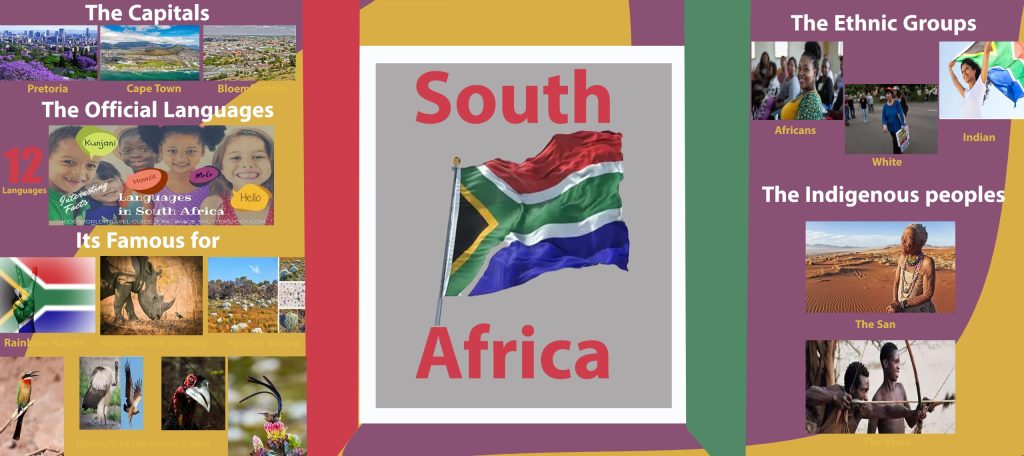
The Official Languages
12 Languages
The 2022 census data indicates that
isiZulu is the most widely spoken home language, used by 24.4% of the population, followed by isiXhosa at 16.3%.
South Africa has twelve official languages, as recognized by its 1996 Constitution and subsequent amendments. These are Afrikaans, English, isiNdebele, isiXhosa, isiZulu, Sepedi (also known as Sesotho sa Leboa), Sesotho, Setswana, siSwati, Tshivenda, Xitsonga, and South African Sign Language (SASL), which was officially recognized in 2023. the inclusion of South African Sign Language marked a significant step in acknowledging the linguistic diversity of the country’s deaf and hard of hearing communities. other languages, such as Afrikaans (10.6%), Sepedi (10%), and English (8.7%), also have substantial numbers of home language speakers.
The Official Religion
South Africa has never had an official state religion
The country’s constitution explicitly guarantees freedom of religion, conscience, thought, belief, and opinion.
While Christianity has historically held a privileged position, particularly during the apartheid era when the Dutch Reformed Church was closely aligned with the National Party
, this status ended with the adoption of the democratic constitution in 1994.
Today, South Africa is a secular state where all religions are afforded equal protection under the law.
Its Famous For
Rainbow Nation
South Africa is known as the “Rainbow Nation” thanks to its mix of cultures across the country. The status of being a cultural “melting pot”
A megadiverse country
Endemism refers to a species being found only within a single, defined geographic region (such as a country, island, or other defined zone). This is distinct from indigenous/native species, which are species that are part of a given ecosystem where their presence is the result of only local, natural evolution. In other words, a species can be indigenous to multiple countries, for example, but a species can be endemic to only one country.
It has wildlife wonderland
Fynbos is a big part of this biodiversity
It’s a small belt of natural shrubland or heathland vegetation, located in the Western Cape and Eastern Cape provinces of South Africa. The area is predominantly coastal and mountainous, with a Mediterranean climate. (emphasis is my own), “The fynbos ecoregion is within the Mediterranean forests, woodlands, and scrub biome. In fields related to biogeography, fynbos is known for its exceptional degree of biodiversity and endemism, consisting of about 80% (8,500 fynbos) species of the Cape floral kingdom, where nearly 6,000 of them are endemic. The Cape Floristic Province: There’s a difference between the Cape floral kingdom, and the Cape Floral Region. The latter is part of the former, “The Cape Floral Region is a floristic region located near the southern tip of South Africa. [However], it is the only floristic region of the Cape Floristic Kingdom, and includes only one floristic province, known as the Cape Floristic Province” In 2004, the “Cape Floral Region Protected Areas” were inscribed as a World Heritage Site (which are areas and landmarks that have legal protection by an international convention administered by UNESCO, for the areas and landmarks having cultural, historic, or scientific significance. The sites are deemed to contain cultural and natural heritage that is considered to be of outstanding value to humanity. Now that really is something special)
South Africa boasts 10% of the world’s bird
fish and plant species as well as 7% of its mammal and reptile species! Lions, elephants and giraffes may not roam the city streets, but nature and animals are never too far away. From vervet monkeys swinging through tree-lined streets in the suburbs of Durban and baboons frolicking around Cape Point to seals visiting the Hout Bay harbour in search of a fishy snack and an array of bird species taking to the sky at any given moment. Wildlife is all around, for an unforgettable bucket-list activity, search for the famous Big 5 (lion, leopard, elephant, rhino and buffalo) on safari in one of South Africa’s national parks or private game reserves. A South African safari is an experience like no other!
Saffers (South Africans) have a very unique and special culture
one which I identify with, and am proud of. Being South African is definitely a part of my identity, and I love that that’s the case, South Africans are friendly , warm, welcoming, helpful, kind, open, outspoken, know-where-you-stand, easy-going, funny, and chatty people.
The Innovation
Inventions and innovations from South Africa include early internet company Thawte, which focused on digital certificates and internet security (founded by Mark Shuttleworth, the first South African to go to space, and the world’s second ever space tourist); computer-assisted tomography (CT scans); crystallographic electron microscopy techniques; the Yellow Fever vaccine; the first automotive fuel produced from coal (by SASOL); the automated pool cleaner; dolosse; the Tellurometer; and the first controlled use of fire by humans (as per the earliest evidence we have of such, at Swartkrans, 1.5 million years ago). South Africa has cultivated a growing astronomy community. It hosts the Southern African Large Telescope, which is the largest optical telescope in the southern hemisphere.
Ethnic Groups
Race is a social construct, and shouldn’t matter. But, historical and present day society has decided it does, and it has an impact. So, as much as I’d like it not to be a thing, since I don’t care what color someone’s skin is, I don’t get to choose how demographers work. And race is part of demographic data. So, I’ll be talking about it here.
As per that 2022 census, the ethnic makeup of South Africa was as follows:
81.45%: African (including Zulu, Xhosa, Tswana, Pedi, Basotho, and other ethnic groups)
8.15%: Colored *
7.27%: White (including the Afrikaner ethnic group)
2.74%: Indian
0.39%: Other ethnic groups
The “colored” is an official racial group in South Africa and refers to people who have multiracial ethnicity. We have communities and individuals choosing to refer to themselves as colored through to the present day. It’s not a racial slur like it is in the United States. there are so many different communities and cultures mixing their lives and lifestyles with one another, and sharing their traditions. It’s a truly wonderful thing. South Africa’s population grew by an estimated 1.82% in 2022. It’s expected, by the UN, to reach around 80 million people by 2100. Not massive growth by any means, but still notable. And still growth.
Indigenous peoples
South Africa is also home to two indigenous population groups; the San and the Khoekhoe. These two groups don’t identify themselves as black. In the 2011 census, many San people chose the “other” racial category, while many Khoekhoe people chose the “colored” category.
“San” is actually a derogatory Khoekhoe word used to refer to foragers without cattle or other wealth. However, the San Council testified that is has no problem with the word San being used in a positive way, and the Court ruled that it is not derogatory. the San peoples are one of the oldest cultures in the entire world, and the largest number of San actually live in neighboring Botswana.
A set of tools that is almost identical to that used by the modern San, dating to 42,000 BCE, was discovered at Border Cave in the SA province of KwaZulu-Natal
in 2012.
UNESCO has recognized Khoe-speaking culture via its inscription of the Richtersveld region, in South Africa’s Northern Cape province, as a World Heritage Site.
Excellent
Thanks @Martin Kobia
Thanks a lot